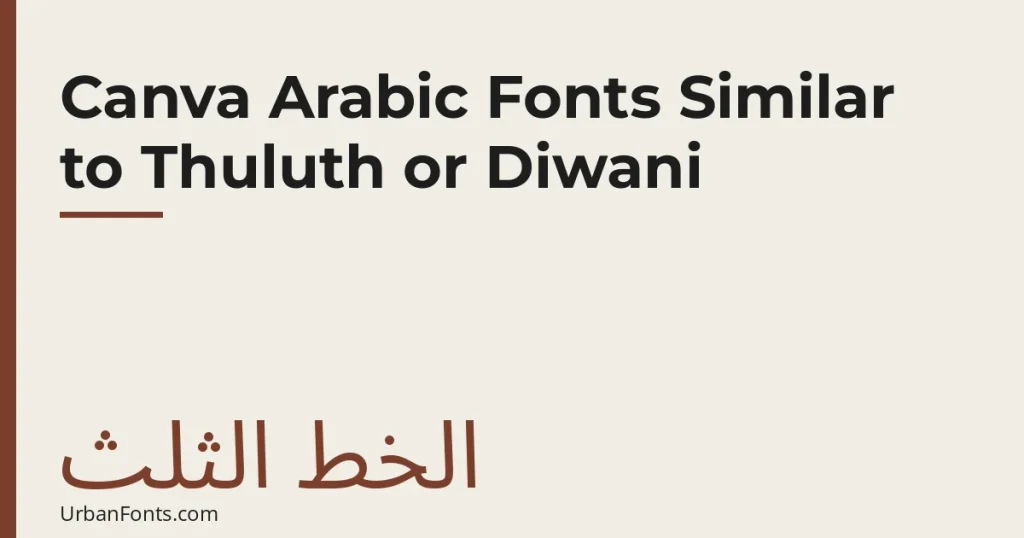
If you are looking for Canva Arabic fonts similar to Thuluth or Diwani, the honest answer is that no free font in Canva or Google Fonts is a true Thuluth or Diwani. Those are hand-written calligraphic styles that depend on stacking and overlapping letters, and typefaces can only imitate them. The closest free options with a calligraphic feel are Katibeh (a Naskh headline font with some Thuluth qualities, according to its own description), Aref Ruqaa (Ruqaa style), and the Naskh fonts Amiri and Scheherazade New.
What Thuluth and Diwani actually are
Both are styles of Arabic calligraphy, written with a cut reed pen (qalam), not typeface categories. Knowing what they look like helps you judge what a font is really giving you.
Thuluth
Thuluth (ثلث, “one third”) is one of the classical “six scripts” of Arabic calligraphy, which are traditionally linked to the codification work of Ibn Muqla in the 10th century and later refinement by other masters. It is known for tall, slightly curved vertical strokes (alif and lam), deep sweeping bowls below the baseline, and a stately, balanced rhythm. Because it is so legible and imposing, it has long been used for mosque inscriptions, large headings, and chapter titles. Calligraphers often fill gaps with small vowel marks and ornaments.
Diwani
Diwani (ديواني) is an Ottoman cursive style that took shape in the imperial chancery, roughly in the 15th to 16th centuries (sources differ on exact dates and attribution). Its letters are compact and joined tightly, and the lines of text tend to rise toward the left end. It was used for official decrees and is often described as hard for non-specialists to read. Jali Diwani is the dense, decorative variant, where dots and small marks fill almost every gap. The name is usually connected with the divan, the imperial council.
| Style | Look | Traditional use |
|---|---|---|
| Thuluth | Tall verticals, big curves, spacious and monumental | Inscriptions, titles, architecture |
| Diwani | Compact, flowing, rising lines, dense joins | Ottoman official documents, decorative panels |
| Naskh | Clear, regular, small proportions | Books, Qur’an copies, body text |
| Ruqaa | Short, simple, quick, angular joins | Everyday handwriting, comics, signage |
| Kufic | Geometric, angular, horizontal emphasis | Early Qur’ans, architecture, logos |
Naskh, Ruqaa, and Kufic are the styles most Arabic typefaces are based on, because they work in running text. Thuluth and Diwani are mostly used as artwork, so they are the hardest to turn into a font.
Why a font can only come close
A calligrapher writing Thuluth chooses each letter’s size, angle, and position based on the whole composition. A font has to pick from a fixed set of shapes that join automatically. Some commercial typefaces use extra OpenType features to imitate this (for example, DecoType’s Thuluth, which is a paid product), but the usual Google Fonts families do not try to reproduce it. So treat any font marketed as “Thuluth style” or “Diwani style” as an interpretation and compare it with real calligraphy before you rely on it.
macOS includes system fonts with Diwani in their names (such as Diwani Letter). Apple’s licence terms for system fonts are restrictive, so check them before using these in a design that you export, upload to Canva, or sell.
What Canva offers for Arabic
I could not find an official, current list of Arabic fonts in Canva, and the font library changes over time, so I am not going to name specific ones as definitely available. Canva lists Arabic among the languages its translation tool supports, so Arabic text is supported in the editor. To see what you have:
- Add a text box and type or paste a short Arabic phrase.
- With the text selected, open the font menu and scroll through the list. Fonts that do not contain Arabic letters will not render them correctly.
- Try each candidate at the size you plan to use, and look at the joins, the dots, and any diacritics.
If the built-in selection does not have a calligraphic look, you can upload a font to your Brand Kit. Canva accepts TTF, OTF, and WOFF files on paid plans where your role has upload permission, and Canva’s help page states that it does not support variable fonts. Our guide to how to upload a font to Canva walks through the steps. See Canva’s own page on Brand Kit fonts for the current rules.
Free Arabic fonts with a calligraphic feel
The fonts below are on Google Fonts under the SIL Open Font License, which allows commercial use. The style notes come from each family’s own description on Google Fonts. Browse the full list with the Arabic filter on Google Fonts.
| Font | Based on | Good for | Not a good match for |
|---|---|---|---|
| Katibeh | Naskh, with some Thuluth qualities | Headlines, posters, covers | Long paragraphs at small sizes |
| Aref Ruqaa (Regular, Bold) | Classical Ruqaa | Titles, invitations, quotes | Anything that must look like Thuluth |
| Amiri | Classical Naskh (Bulaq Press revival) | Books, formal text, quotes | Heavy display use |
| Scheherazade New | Traditional Naskh | Religious and literary text, wide script coverage | Modern branding |
| Noto Naskh Arabic | Modulated Naskh | Reliable multi-language text | Decorative titles |
| Noto Nastaliq Urdu | Nastaliq | Urdu; hanging, slanted lines | Standard Arabic layouts, tight line spacing |
| Reem Kufi | Kufic (early Kufic models) | Titles, logos, an old-world geometric look | Thuluth, which is a curved style |
| Marhey | Playful custom hand lettering | Casual, friendly designs | Formal or religious projects |
| Rakkas | Ruq’ah lettering from Egyptian film posters | Bold display text | Body text |
Two notes on that list. Reem Kufi is a Kufic design, which is angular and geometric, so it will not give you the sweeping curves of Thuluth, even though it is a popular “Arabic heritage” choice. Lateef (SIL) is another well-known SIL family, but it was designed with Sindhi and other South Asian languages in mind, so it is a language-coverage choice more than a style one.
If you only need the vibe of a decorative Arabic title, Katibeh at a large size is the nearest free match to Thuluth in this list, and Aref Ruqaa gives the quick, rounded energy of everyday hand lettering. Browse more on our Arabic fonts and calligraphy fonts pages.
A quick check before you upload: some Google Fonts families (for example, Noto Naskh Arabic) are variable fonts. If you download one for Canva, use the static font files from the zip, because Canva does not support variable fonts.
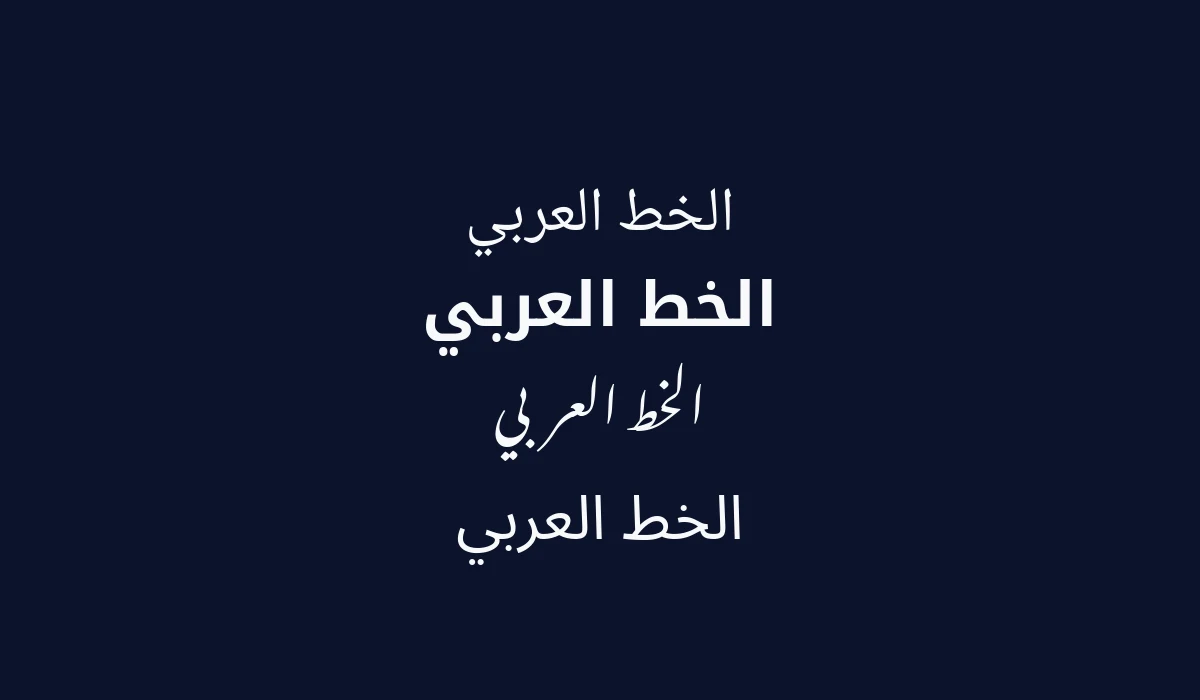
Getting the text to behave in Canva
Arabic letters change shape depending on where they sit in a word, and the text runs right to left. A few habits avoid most problems:
- Type with an Arabic keyboard layout where possible. Text pasted from some generators uses “presentational forms” that look joined but are not real letters, and they can break in search, translation, and screen readers.
- Do not add letter spacing. Extra tracking pulls apart joined letters. If you want airier text, increase size or line height instead.
- Give calligraphic fonts more line height. Tall ascenders and deep descenders can collide.
- Check mixed text. Numbers, brand names in Latin letters, and punctuation can appear in an unexpected order next to Arabic. Read the final line carefully.
- Test effects. Curved text or heavy effects can distort connected letters. Preview before exporting.
- Have a native reader proof the final design. A single wrongly joined letter can change a word.
If you do not know which font a sample uses, try the methods in find a font from an image. Arabic identification is less reliable than Latin, so the result is a starting point.
When you really need Thuluth or Diwani
For a wedding, a logo, or a mosque project that must show true calligraphy, hire a calligrapher and get the artwork as a vector file or high-resolution image. You can place that in Canva as an image or SVG. A font will give you consistent, editable text. A calligrapher gives you the real style. Many designers use both: calligraphy for the single hero word, and a readable Naskh or sans font for everything else.
Frequently asked questions
Is there a free Thuluth font in Canva?
Not that I could verify. Canva’s font list changes and has no official Arabic list, and the free Google Fonts families (Katibeh, Aref Ruqaa, Amiri and others) are Naskh, Ruqaa, or Kufic-based designs, not true Thuluth. You can upload a font you have a licence for if you are on a paid Canva plan.
What is the difference between Thuluth and Diwani?
Thuluth is a classical script with tall, curved strokes and wide spacing, used for inscriptions and titles. Diwani is a compact, flowing Ottoman chancery script, mostly used for official documents and decorative panels. Diwani is harder to read.
Is Reem Kufi a Thuluth font?
No. Reem Kufi is based on Kufic, which is angular and geometric. It suits titles and logos with a heritage look, but it does not have Thuluth’s curves.
Which free Arabic font is closest to Thuluth?
Katibeh is the closest on Google Fonts, because its description says it is a Naskh headline font with some qualities of the Thuluth script. It is still an interpretation, so compare it with real calligraphy.
Does Canva handle right-to-left Arabic text properly?
Arabic is supported in the editor, but I could not find official details on every right-to-left behaviour. Type with an Arabic keyboard, avoid letter spacing, check numbers and Latin words in mixed lines, and have a native reader proof the final design.