Estimating your home’s value before selling is less about finding one perfect number and more about building a realistic range. A personalized report from Kelley Blue Book Homes can be a useful starting point, especially when you pair it with recent neighborhood sales and an honest review of your property’s condition.
Your likely sale price can change with local buyer demand, competing listings, financing conditions, and the features buyers value in your area. The goal is to develop a well-supported estimate that helps you decide whether to sell, how to prepare, and what you may take away from the transaction.
Key Takeaways
-
Use recent nearby sales to establish a realistic value range.
-
Compare location, size, condition, layout, lot, and upgrades.
-
Review active and pending listings to understand current competition.
-
Use online estimates as a starting point, not a final price.
-
Separate market value, asking price, final sale price, and net proceeds.
-
Consider a comparative market analysis or appraisal when the situation calls for one.
Why a Price Range Is Better Than One Number
A home does not have a fixed price tag. Its estimated market value is the likely range buyers may pay under normal market conditions. Your asking price is the amount you list, while the final sale price is what a buyer ultimately agrees to pay. Net proceeds are what may remain after your mortgage payoff and selling expenses.
For example, a seller may estimate a home at $500,000 to $525,000 based on similar recent sales. Listing at $515,000 may attract interest, but inspection findings, concessions, or stronger-than-expected demand can move the final result. A range leaves room for those real-world variables.
Start With Recent Comparable Sales
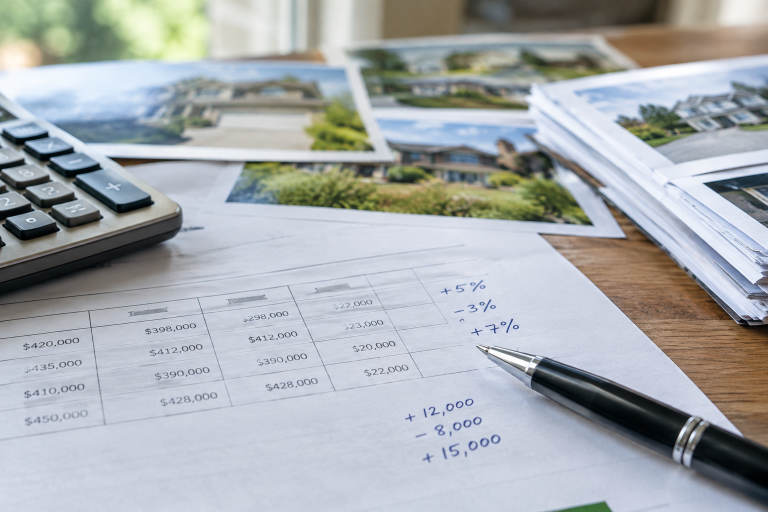
Comparable sales, commonly called comps, are recently sold homes that buyers would likely view as alternatives to yours. Closed sales are generally more useful than asking prices because they show what a buyer actually agreed to pay. Guidance on selecting comparable sales emphasizes matching properties with similar physical characteristics and market appeal.
Begin with three to six homes near yours, then compare their square footage, age, architectural style, number of bedrooms and bathrooms, lot size, condition, and finish level. A home in the same neighborhood is often more useful than a similar-looking property farther away because it shares more of the same location advantages and drawbacks.
Adjust for the Details Buyers Notice
Two homes with similar square footage can command very different prices. Buyers may place greater value on an updated kitchen, remodeled bathrooms, a functional layout, usable outdoor space, garage parking, storage, views, privacy, or a finished basement. They may discount a home with deferred maintenance, traffic noise, water damage, aging systems, or an awkward lot.
Before estimating value, make a simple property file. Include upgrade dates, permits, warranties, repair invoices, roof and HVAC ages, and notes about work that still needs attention. This record helps you fairly compare your home to nearby sales.
Check Active and Pending Listings
Active listings show the choices buyers can see today. Pending listings can provide clues about which homes are attracting accepted offers, although the final price is not public until the sale closes. Do not assume an active listing proves market value, since a seller can choose any asking price.
Compare your home’s price, photos, condition, location, and features with nearby competition. If similarly priced homes offer more updates or a better layout, your pricing or preparation plan may need to change.
Use Online Estimates With Care
Automated valuation tools commonly rely on public records, prior sales, property data, and market trends. They can be helpful for an early estimate, but they may not account for a recent renovation, poor upkeep, an unusual floor plan, or a location issue that is obvious in person.
Review more than one estimate and focus on the evidence behind each one. Estimates can be less dependable for rural homes, distinctive properties, new subdivisions, and neighborhoods with few recent transactions.
Know the Difference Between a Valuation and an Appraisal
A general valuation is an estimate used for planning, pricing, or deciding whether a move makes financial sense. An appraisal is a professional written opinion of value prepared for a specific purpose. The role of a home appraisal is especially important in lending and refinancing, and it may also matter in estate, tax, divorce, or legal situations.
Most sellers do not need a formal appraisal just to choose an initial listing price. A local real estate professional’s comparative market analysis may be enough for ordinary sale planning.
Build a Simple Home Value Worksheet
-
List three to six recent nearby closed sales.
-
Record each home’s sale price, size, age, condition, and major features.
-
Mark meaningful differences between each comp and your home.
-
Note whether each difference may increase, reduce, or have little effect on value.
-
Review active and pending competition.
-
Create low-, middle-, and high-price scenarios with written assumptions.
Calculate Likely Net Proceeds
Sale price alone does not tell you what you may keep. Start with this basic calculation:
Expected sale price − mortgage payoff − selling costs = estimated net proceeds
Selling costs can include agent compensation, seller-paid closing costs, repairs, preparation expenses, buyer concessions, moving costs, transfer charges, taxes, and association-related fees. Estimating proceeds early can help you decide whether selling will support a relocation, a retirement plan, a debt payoff, or another goal.
Decide Which Repairs Are Worth Doing
Prioritize repairs that improve safety, function, cleanliness, and buyer confidence. Address leaks, visible water damage, broken fixtures, peeling paint, odors, stains, overgrown landscaping, and problems likely to arise during an inspection. Avoid assuming every major remodel will return its full cost at resale.
When to Refresh Your Estimate
Update your range when a relevant nearby sale closes, a competing home goes under contract, your listing timeline changes, mortgage rates move, affordability is affected, or you complete a significant repair or upgrade. Once listed, buyer feedback can also reveal whether the original price matches market expectations.
Common Questions Homeowners Ask
How accurate are online home value estimates?
They can be useful directional tools, but accuracy varies by property and market. Verify the estimate against recent comparable sales and your home’s actual condition.
Should assessed value set my asking price?
Usually not. Tax assessments serve local property-tax purposes and may not reflect current buyer demand or recent neighborhood sales.
What if estimates vary widely?
Review comparable properties, check property details for errors, document upgrades, and request a comparative market analysis before relying on a single figure.
Conclusion
You do not need a perfect prediction to make a confident decision to sell. Recent comps, current competition, a realistic condition assessment, and a clear net-proceeds estimate can produce a practical value range. Use that range to plan repairs, set expectations, and prepare for your next move.