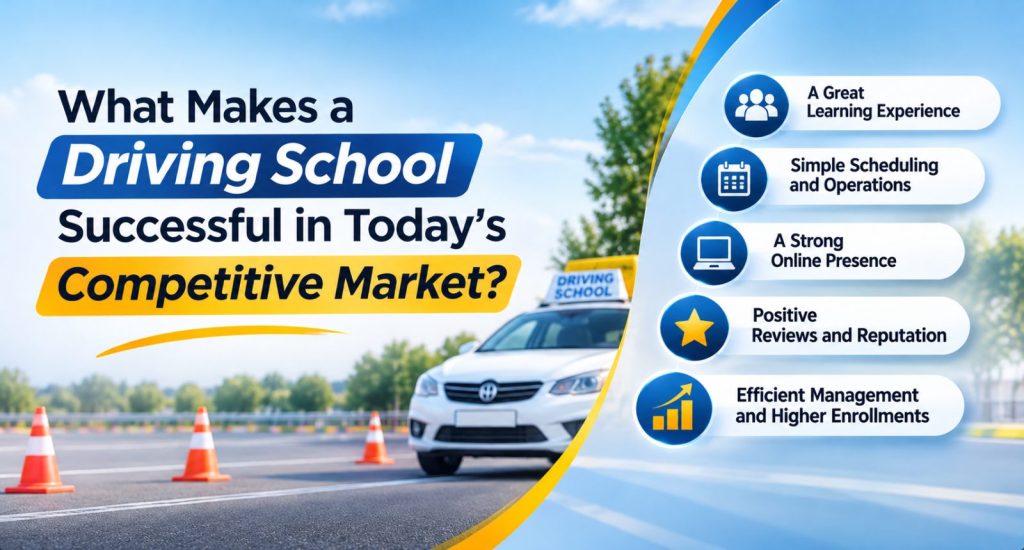
Competition in driver education no longer comes only from the school across town. Families now weigh regional chains, independent instructors, and online course providers before making a single phone call, often within the same search session. In this environment, offering lessons at a fair price is the baseline, not the differentiator.
The schools that grow consistently share a set of deliberate choices. They know which students they serve best, they treat instructor quality as a product standard, and they run their operations on reliable systems such as driving school management software, so scheduling, payments, and student progress never depend on memory or paperwork.
They also understand that reputation is now earned and discovered largely online. A school with excellent instructors can still lose enrollments to a less capable competitor that simply presents itself better in local search results. Partnering with a website design and local seo marketing agency is one way established schools close that gap and make sure their online presence reflects the quality of their training.
The sections that follow outline the qualities that distinguish successful driving schools in today’s market, and how owners can build each one into their business.
How the Competitive Landscape Has Shifted
For decades, driving schools competed mainly on location and word of mouth. That model has weakened considerably.
A growing number of states permit online instruction for the classroom portion of driver education, which allows course providers with no local presence to capture part of each student’s spending. Regional operators with multiple branches compete on brand recognition and wider availability. Independent instructors use social media to promote lower rates and flexible hours.
Each of these competitors holds a narrow advantage, whether price, convenience, or scale. An established local school rarely wins by matching them on their own terms. It wins by being clearly better at what families value most: safety, patience, and a dependable path to a license.
Families have changed how they evaluate options as well. Many start with online reviews, compare package pricing across several schools, and expect to enroll, pay, and schedule lessons without visiting an office.
As a result, success depends less on being the most convenient school nearby and more on being the most credible choice a family finds.
Clarity About Who the School Serves
Schools that try to serve every type of learner with the same program often end up competing on price alone. Successful schools identify their strongest audiences and design their offerings around them.
That might mean a structured teen program aligned with state graduated licensing requirements, a patient adult beginner track for learners who feel anxious behind the wheel, refresher lessons for older drivers, or intensive road test preparation for students working against a deadline. Each audience has different concerns, schedules, and decision makers. The message that persuades the parent of a 15-year-old will rarely resonate with a 40-year-old first-time driver.
A clear position also simplifies pricing. Packages built for a defined audience are easier to explain, easier to justify, and far less vulnerable to discount-driven competition.
Instructors Who Deliver a Consistent Standard
From the student’s perspective, the instructor is the school. Two lessons with two different instructors should feel like parts of one program, not two unrelated experiences.
High-performing schools achieve this through a documented curriculum, shared lesson objectives, and progress notes that every instructor reviews before a session begins. When a student moves from one instructor to another, the new instructor already knows which skills have been covered and which still need practice.
Retention matters just as much as training. Experienced instructors build personal reputations that generate referrals, and replacing them is slow and costly. Schools that offer predictable schedules, fair compensation, and tools that reduce paperwork tend to keep their best people longer, which in turn protects the consistency families are paying for.
Ongoing development reinforces both goals. Periodic ride-along observations, peer reviews of lesson notes, and short refresher sessions on updated state requirements keep standards high without turning professional development into a burden.
Results Families Can See
Parents are not simply buying lesson hours. They are buying confidence that their son or daughter will become a safe, licensed driver. Successful schools make that progress visible at every stage.
Brief progress updates after each lesson, clearly defined skill milestones, and honest readiness assessments before a road test all build trust. Schools that also track first-attempt pass rates and average time to licensure gain something even more valuable: evidence. Those figures strengthen marketing claims, guide instructor coaching, and reveal which parts of the curriculum need refinement.
Transparency reduces friction too. Families who can see what has been accomplished are far less likely to dispute charges or question a recommendation for additional lessons.
Technology Shaped Around the School
A modern student experience now includes online enrollment, digital payments, self-scheduling, and progress tracking from a phone. Behind the scenes, the same systems manage instructor assignments, vehicle availability, and the training records many states require schools to maintain.
The difficulty is that many off-the-shelf platforms are built around a generic workflow. Schools with distinctive programs, multiple locations, or state-specific requirements often end up adjusting their processes to fit the software instead of the other way around.
For this reason, some schools are moving toward platforms shaped around their own operations. NewAgeSysIT, a custom software development company, works with driving schools to tailor a proven driving school platform to each school’s workflow, typically including a branded admin portal, an instructor app, and a student app. The school owns the finished platform, so its technology can evolve alongside new programs and locations without recurring per-user fees.
Whatever system a school selects, the measure of success is straightforward: it should remove administrative work from the team’s day, not add to it.
Reputation Built Deliberately
In a crowded market, a strong reputation is rarely accidental. Successful schools request reviews at the moments when satisfaction peaks, such as right after a student passes the road test, and they respond professionally to every review, including the critical ones. A thoughtful reply to a negative review often reassures prospective families more than a dozen five-star ratings.
These schools also invest in local relationships. Partnerships with high schools, community organizations, and employers who need licensed staff create referral channels that newer competitors cannot easily replicate.
Finally, they make sure that reputation is visible at the moment families search. A well-maintained Google Business Profile, a fast and informative website, and consistent business details across online directories turn years of good work into enrollments.
Financial Discipline Behind the Growth
Competitive pressure tempts many schools into discounting. The more successful ones understand their numbers well enough to resist it. They know the true cost of a lesson hour, including instructor pay, fuel, insurance, vehicle maintenance, and administrative time, and they price packages to protect that margin.
They also plan for seasonality. Summer and school breaks bring sharp spikes in teen enrollment, while other months run noticeably slower. Schools that fill quieter periods with adult programs, fleet safety training for local employers, or instructor development maintain steadier cash flow and avoid overextending staff and vehicles during peak months.
This discipline creates room to invest. A school with predictable margins can add a vehicle, open a new service area, or upgrade its systems on its own timeline rather than in response to a crisis.
Success Is Built as a System
No single factor makes a driving school successful today. Lasting advantage comes from how well positioning, instruction quality, visible outcomes, technology, reputation, and financial control reinforce one another.
Schools that strengthen each of these areas steadily build an advantage that price cuts and new market entrants struggle to challenge. In a market where families have more options than ever, becoming the school they trust most remains the most durable competitive position available.